
Much ado about fuel – A supply chain story under the RTCCO
Market Insights
Postscript – June 2026: At the time of publication, the United States and Iran have announced that a peace agreement has been reached, including a cessation of hostilities, although the agreement is yet to be formally signed and implemented. While it remains to be seen how this will affect global fuel markets, sustained easing of geopolitical tensions may place downward pressure on fuel prices. If that occurs, it may in turn accelerate the circumstances in which the RTCCO ceases to operate (given its link to fuel price thresholds), highlighting the inherently responsive and cyclical nature of the regime.
In this article, we step slightly away from the ACL to consider another regulatory development currently affecting the transport industry, being the Road Transport Contractual Chain Order – Fuel Cost Recovery 2026 (RTCCO).
What is at stake, and what does it mean for you?
The RTCCO sits within an existing framework in the Fair Work Act 2009 (Cth) (Act) for regulating how road transport is contracted and paid for across a supply chain. You might be wondering why the Act is relevant to your business, particularly if you do not engage transport workers directly.
Surely this has nothing to do with you. Well, not necessarily.
If you sit anywhere within a chain of arrangements under which goods are transported by road for another party, the RTCCO may apply to you.
In those circumstances, adjustments to your pricing and contractual arrangements may be required. This may be the case even where your contract contains a mechanism to adjust the price for fuel fluctuations if that mechanism does not meet the cost recovery requirements of the RTCCO.
At its core, the regime applies where road transport work is performed through a series of contractual arrangements for another party.
In this article, we explain how the regime operates in practice, using a typical supply chain scenario to illustrate the obligations that arise, with a nod to Shakespeare.
The RTCCO remains subject to ongoing review, and a number of proposed changes (discussed later in this article) are intended to provide an indication of how the Commission expects the regime to operate in practice.
The cast
Messina Markets
Messina Markets is a national retailer with a large bricks and mortar and online presence, operating a network of stores and distribution centres across Australia. Under its agreement with Leonato Wholesale Group, Leonato is responsible not only for supplying goods, but also for arranging delivery of those goods into Messina’s retail and distribution network.
Leonato Wholesale Group
A large wholesaler of goods which are supplied to supermarkets. Leonato Wholesale Group contracts with Claudio Logistics for the delivery of goods to Messina Markets stores across Australia.
Claudio Logistics
A mid-tier transport and logistics provider engaged by Leonato Wholesale Group to manage its transport network. Claudio Logistics coordinates linehaul and distribution, using a combination of its own fleet and subcontracted drivers.
Benedick (owner-driver)
An independent contractor engaged by Claudio Logistics to perform deliveries, including last mile and metro work. Benedick supplies his own vehicle and also undertakes work for other logistics providers and clients.
Ursula (subcontracted driver)
A small, independent driver engaged by Benedick on an ad hoc basis to carry out regional and rural deliveries that Benedick cannot service directly. Ursula typically performs work on a per job basis and has even less control over pricing than Benedick.
Before the RTCCO
Messina Markets’ agreement with Leonato Wholesale Group is structured as a supply arrangement under which Leonato is responsible for sourcing and delivering goods to Messina Markets’ retail network at agreed fixed and variable prices (which do not specifically account for fuel cost fluctuations).
Leonato Wholesale Group’s agreement with Claudio Logistics is structured as a fixed price transport and logistics services contract. The commercial risk of delivering the transport outcomes, including fuel cost fluctuations, sits with Claudio Logistics.
Claudio Logistics, in turn, allocates work across its network. Some deliveries are performed by its own fleet, while others are subcontracted to drivers such as Benedick. The rates paid to subcontractors are typically fixed on a per delivery or per kilometre basis, with limited mechanisms for adjustment.
When fuel prices rise sharply:
- Messina Markets continues to pay the agreed contract price to Leonato Wholesale Group;
- Leonato Wholesale Group continues to pay the agreed contract rate to Claudio Logistics;
- Claudio Logistics bears the increased fuel cost under its upstream contract, but manages this through its broader operations;
- Benedick feels the impact most acutely, as fuel is a direct, out of pocket expense and his ability to recover increased costs through pricing is limited; and
- Ursula is even further exposed, as she is relying on work offered by Benedick at fixed or ad hoc rates, with little visibility or ability to recover increased fuel costs.
After the RTCCO
At a high level, the RTCCO requires primary and secondary parties in a road transport contractual chain to ensure that increases in fuel costs are reflected in the rates paid through that chain. A contractual chain may arise wherever road transport work is performed through successive arrangements for another party, and does not require a regulated road transport contractor to be present at the end of the chain.1
Primary parties are those who are parties to the first contract or arrangement in the contractual chain. As noted above, a contractual chain arises where road transport work is performed through a series of contractual arrangements for another party. In our cast, the parties to the first contract are Messina Markets and Leonato Wholesale Group. In practice, primary parties will often comprise retailers, manufacturers or other principals.
There is, however, some uncertainty as to whether a road transport contractual chain extends to upstream parties such as end customers (like Messina Markets), or instead commences at the point at which transport is arranged (for example, at the Leonato – Claudio level), where it is more readily apparent that road transport work is being performed for another party. Industry feedback following the introduction of the RTCCO has highlighted difficulties in identifying primary parties in complex supply chains, particularly where end customers have limited visibility of downstream transport arrangements.
For the purposes of this example, we have proceeded on the basis that the broader construction applies, such that the transport work may be characterised as being performed for Messina Markets.
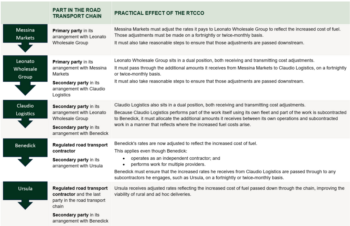
Primary parties are required to adjust pricing under their contracts with one another to reflect increased fuel costs, and (subject to some exceptions discussed below) are also required to take reasonable steps to ensure that those adjustments are passed through the chain by secondary parties. Secondary parties are those who are parties to subsequent contracts or arrangements in the contractual chain. In our cast, this includes Leonato Wholesale Group in its arrangement with Claudio Logistics, Claudio Logistics in its arrangement with Benedick, and Benedick in his arrangement with Ursula. This illustrates that a party may operate in a dual capacity within the chain. For example, Leonato Wholesale Group is a primary party in its arrangement with Messina Markets, but a secondary party in its downstream arrangement with Claudio Logistics. In practice, secondary parties will often include transport providers, fleet operators and other intermediaries in the chain.
Regulated road transport contractors are those who perform road transport work under a services contract (rather than as employees), where the work under that contract is carried out by an individual, including where that individual operates through an entity.
Let’s take a look at how this applies to our cast members.
How the RTCCO allocates responsibility across our cast
Set out below is a diagram which shows how the RTCCO applies to our cast. For the purposes of the Act, only parties to the first contract or arrangement are ‘primary parties’. Parties to all subsequent contracts or arrangements are classified as ‘secondary parties’, even where they act as the contracting principal in those arrangements. A party may also fall within more than one category (for example, as both a primary party and a secondary party and as a secondary party and a regulated road transport contractor) depending on its role in different parts of the chain.
How does the RTCCO apply in a mixed model, like Claudio Logistics?
In our scenario, Claudio Logistics operates a mixed model, performing some work through its own employee drivers and subcontracting other work to operators such as Benedick. The RTCCO applies to Claudio Logistics’ contractual relationships within the chain, including its arrangement with Leonato Wholesale Group and its subcontracting arrangements with Benedick, but does not extend to its internal employment relationships.
A simple example demonstrates how this could work in practice (noting that actual approaches will depend on the structure of the relevant contracts and cost allocation methodologies adopted by the parties).
If Claudio Logistics receives a $200 adjustment from Leonato Wholesale Group to reflect increased fuel costs under the RTCCO, that amount is not passed through in full to each party in the chain. Instead, it must be allocated by reference to where those increased costs arise. For example, if 60% of the increased costs relate to work performed by Claudio Logistics’ employee fleet and 40% to subcontracted work performed by Benedick, Claudio Logistics must pass through the relevant portion of the adjustment to Benedick, in this case $80. The balance ($120) may be retained by Claudio Logistics to meet the increased fuel costs associated with its employee fleet. Where Benedick in turn subcontracts work to Ursula, the same principle applies, with the relevant portion of the increase flowing further down the chain.
Can a regulated road transport contractor also be a secondary party?
Yes. In our example, Benedick is a regulated road transport contractor in his arrangement with Claudio Logistics. However, where Benedick engages a further subcontractor, such as Ursula, to perform road transport work under a services contract, he will also be a secondary party in that downstream arrangement. In that capacity, Benedick is required to ensure that cost adjustments received under the RTCCO are passed through to those downstream contractors, in this scenario to Ursula. This obligation applies by reference to his role in the downstream arrangement, regardless of whether he is also a regulated road transport contractor in another part of the chain.
Are there any exemptions that our cast members can rely on?
Not in this scenario.
While the RTCCO has broad application across road transport contractual chains, there are limits on both who is captured by the regime and the obligations that apply to particular parties.
The exclusions operate at two different levels.
First, the Act itself limits who is taken to be part of a road transport contractual chain. For example, under section 15RA(3) of the Act, arrangements that are purely private or domestic in nature fall outside the statutory concept of a road transport contractual chain. In addition, while employees may perform work within a chain, they are not themselves treated as persons in the chain for the purposes of the Act.
Secondly, the RTCCO contains more limited carve outs that affect the obligations of parties who are otherwise within the chain. For example, clause 4.3 of the RTCCO provides that the obligation on a primary party to take reasonable steps to ensure that secondary parties pass on fuel cost adjustments does not apply to certain primary parties. Currently, a primary party which is a small business employer and which is not a road transport business is exempt from that obligation. This does not exempt these parties from the obligation to adjust rates. It only affects their obligation to take reasonable steps to ensure those adjustments are passed downstream.2
How are rate adjustments to be implemented?
Under clause 4.6 of the RTCCO, rate adjustment obligations can be satisfied in one of three ways:
- by applying a ‘rise and fall’ formula or cost model rate adjustment under an applicable State or Territory industrial instrument (4.6(a));
- by applying a ‘rise and fall’ formula, cost model or cost benchmark in an applicable collective agreement or contract (4.6(b)). Recent proposed changes to the RTCCO indicate that existing contractual “rise and fall” mechanisms may be relied upon to satisfy these obligations, provided they are implemented in a way that meets the RTCCO’s requirements (that is, any adjustments and pass throughs are made on a fortnightly or twice-monthly basis and operate in a way that is consistent with the RTCCO’s objective of enabling recovery of increased fuel costs); and
- through an agreed ongoing or special arrangement in the contractual chain, under which rates are adjusted by reference to a ‘rise and fall’ formula, cost model or other benchmarking methodology (4.6(c)).
The RTCCO provides that, in the case of an arrangement of the kind described in clause 4.6(c), the relevant formula, cost model or benchmarking methodology may be applied in a standardised way, including by reasonable averaging of increased fuel costs. This express flexibility does not appear in the same terms in relation to the other pathways, although in practice those mechanisms may themselves incorporate similar features.
But we already have a fuel adjustment clause in our contract, does that suffice?
The RTCCO allows rate adjustment obligations to be satisfied where there is an existing rise and fall mechanism in the contract that provides for the recovery of the increased cost of fuel. The ‘increased cost of fuel’ is defined in the RTCCO as the difference between the cost per litre for the type of fuel used to perform the relevant work in the road transport industry at any given time and the cost as it was on or before 6 March 2026.
An existing adjustment mechanism does not need to operate as a precise, transaction by transaction reconciliation of the increased cost of fuel. However, it must operate in a way that is consistent with the types of mechanisms contemplated by clause 4.6, being a formula, cost model or benchmark that responds to fuel movements. Where such a mechanism is applied on a standardised basis (including by averaging, in the manner contemplated by clause 4.7), it may still satisfy the RTCCO, provided it enables recovery of the increased cost of fuel on the required adjustment cycle.
When does the RTCCO come to an end?
The RTCCO is not indefinite.
Its operation is linked to fuel price conditions. Broadly, as it stands, the RTCCO’s obligations cease to apply if the relevant diesel price benchmark falls below a specified threshold, being where the weekly average national terminal gate price for diesel, as reported by the Australian Institute of Petroleum, falls below $2 per litre. However, changes to the terms around the application of this threshold have been proposed following the first review of RTCCO on 25 May 2026 (see below).
Review of the RTCCO
On 25 May 2026, the first review of the RTCCO was conducted by the Expert Panel of the Fair Work Commission. The Expert Panel heard submissions made by unions and industry representatives about proposed changes to the RTCCO following its first month in operation. The submissions discussed, among other things:
- difficulties in identifying the primary and secondary parties within a chain;
- whether a first contract to a chain needs to expressly contemplate road transport works to be captured by the RTCCO;
- the fortnightly or twice monthly adjustment requirements alongside adjustment frequencies listed under contractual arrangements; and
- the requirements for cessation of the RTCCO.
Following the review hearing, the Expert Panel has proposed changes to the RTCCO to address some of these submissions. Among the proposed changes is an update to the conditions of operation, where the weekly average national terminal gate price as reported by the Australian Institute of Petroleum would need to remain below $2.00 per litre for diesel for four consecutive weeks before the RTCCO ceases to operate. Those proposed changes have been subject to public consultation (closing date: 9 June 2026) and may be finalised (with or without modification) following that process. You can read the proposed changes here.
The RTCCO remains subject to ongoing review, with the next review expected approximately three months after the 25 May 2026 review.
What can be done if there is a dispute?
The parties to a dispute must first genuinely try to resolve the dispute between themselves. If the dispute cannot be resolved between parties, a party may refer the dispute to the Fair Work Commission. The Fair Work Commission may use any method it considers appropriate to resolve the dispute, including conciliation, mediation or arbitration (with the consent of the parties). Parties can be represented by a union or employer association.
What practical steps should parties like our cast take to comply with the RTCCO?
Review existing arrangements
Parties to a road transport contractual chain should review their transport contracts to identify how fuel costs are currently dealt with, and whether those mechanisms are capable of meeting the RTCCO requirements. Fixed pricing models with no adjustment mechanism are at risk, and so too are fuel adjustment mechanisms that don’t align with the requirements of the RTCCO.
Map the contractual chain
Understanding where you sit in the chain is critical. Parties need to identify who they receive services from, who they supply to, and where regulated road transport contractors may sit within that structure. This will determine both where adjustments must be made and where they must be passed on.
Ensure systems support regular adjustments
The RTCCO requires periodic adjustments to reflect fuel costs. Businesses should ensure they have processes in place to calculate, implement and pass through those adjustments on the required timetable.
Look beyond their own position
The obligation to comply does not depend on whether others in the chain have complied.
Each party must meet its own obligations, including ensuring that any required adjustments are passed through to downstream contractors.
This article was written by Teresa Torcasio, Partner, Connie Lambropoulos, Senior Associate, and Chau Le, Law Graduate.
1 See section 15RA(1) and (2) of the Fair Work Act 2009 (Cth), which defines a road transport contractual chain to include arrangements under which work is performed by an employee as well as by a regulated road transport contractor, which leads to the conclusion that a chain may end at a secondary party that uses employees to carry out the transport work.
2 The proposed amendments to the RTCCO referenced below in this article, maintain this carve out but clarify its intended scope. In effect, the exception applies only where the relevant primary party is both a small business employer and is not otherwise engaging in road transport activities within the contractual chain (for example, by engaging contractors or employee-like workers, or employing employees to perform road transport work).

Subscribe for publications + events
HWLE regularly publishes articles and newsletters to keep our clients up to date on the latest legal developments and what this means for your business. To receive these updates via email, please complete the subscription form and indicate which areas of law you would like to receive information on.
* indicates required fields