
Growing up fast: The end of junior pay rates for adult workers
Market Insights
On 31 March 2026, the Fair Work Commission (Commission) issued a provisional decision that will fundamentally reshape how employers remunerate younger workers, phasing out junior rates of pay for employees aged 18 years and older. The phase out will impact the General Retail Industry Award 2020, the Fast Food Industry Award 2010 and the Pharmacy Industry Award 2020 from 1 December 2026, with other modern awards expected to follow.
What has been decided?
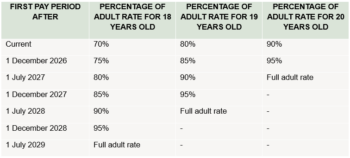
The Commission’s view is that age-based pay discounting for adult employees can no longer be justified. Rather than an immediate abolition of junior rates, the phase-out will be incremental. From December 2026, affected employees will receive a five percentage point increase to their applicable rate every six months until they reach the full adult rate. Critically, this incremental increase will only commence once an employee has completed six months of continuous service with the same employer.
This means a 20-year-old retail worker currently paid at 90% of the adult rate would move to 95% after six months of service, and then to 100% six months later. The trajectory is clear that within a relatively short window, all employees over 18 years of age and who are covered by these awards, will be entitled to the full adult minimum rate.
We have outlined, in the below table, how the incremental increases will apply over time:
The service requirement
The six-month service threshold creates two dynamics that employers need to consider.
First, junior employees who change employers while under 21 years of age reset the service clock. An employee who has worked for 18 months at one business and progressed to the fully adult rate, but who is still under 21 years of age, will revert to a lower junior rate if they move to a new employer, and must begin the incremental increase process from scratch until 1 July 2029. This may impact on labour mobility for younger workers and could give rise to disputes about whether breaks in service or transfers between related entities trigger a reset.
Second, the structure may incentivise some employers to terminate junior employees before they reach six-months of employment, which conduct will attract scrutiny under the general protections provisions of the Fair Work Act 2009 (Cth). Such claims may result in adverse action claims, heavy penalties and reputational damage.
Which employers are affected?
The provisional decision applies to employers covered by the General Retail Industry Award 2020, the Fast Food Industry Award 2010 and the Pharmacy Industry Award 2020. However, the Commission has signalled that this is merely the first tranche of awards to be changed. Other modern awards containing junior rates are likely to be reviewed in subsequent proceedings.
Employers in Western Australia should note that, while the national workplace relations system covers most private sector employers in this state by virtue of the referral of powers, those who remain within the state industrial relations system will not be affected by this decision. However, a flow-on to state instruments is foreseeable in time.
What should employers do now?
Although the decision remains provisional, prudent employers should take preparatory steps now:
- Identify employees aged 18 and over, paid junior rates under the affected awards;
- Model the cost impact of progressive increases commencing on 1 December 2026;
- Review payroll systems to ensure they can accommodate the pay escalation and track relevant service milestones;
- Consider rostering and engagement practices, particularly for casual employees, to ensure workforce management decisions cannot be characterised as adverse action; and
- Brief line managers on the changes and the legal risks associated with terminating junior employees.
Looking ahead
With this decision, the Commission is signalling that age alone is not an acceptable proxy for productivity or experience once a worker reaches adulthood. For employers in affected industries, the implications are real but manageable with proper planning. The broader employment law landscape should be watched closely as the Commission turns its attention to other awards that cover industries with a high percentage of junior employees, such as the Hospitality Industry (General) Award 2020 and the Hair and Beauty Industry Award 2020.
We will provide further updates once the final decision is published. In the meantime, please reach out to us if you have questions about how this change may affect your operations.
This article was written by Danielle Flint, Partner, and Courtney Spencer, Senior Associate.

Subscribe for publications + events
HWLE regularly publishes articles and newsletters to keep our clients up to date on the latest legal developments and what this means for your business. To receive these updates via email, please complete the subscription form and indicate which areas of law you would like to receive information on.
* indicates required fields